
Ceramic Coating Truths: My Detail Guys' Surprising Secrets

5 Surprising Truths About Ceramic Coatings They Don't Tell You at the Dealership
Introduction: The Allure of the Permanent Shine
Every car owner shares a common goal: keeping their vehicle looking as flawless as the day it left the showroom. In the quest for the ultimate shine, ceramic coatings are often marketed as the final word—a permanent, glass-like shield against the elements. While the promise of a long-lasting, brilliant finish is appealing, the reality of the technology is far more interesting—and complex—than most people realize. This article moves beyond the sales pitch to distill the most impactful and surprising facts about ceramic coatings, revealing the true science behind the shine.
--------------------------------------------------------------------------------
1. It’s Not a Super-Wax—It's a Chemical Transformation
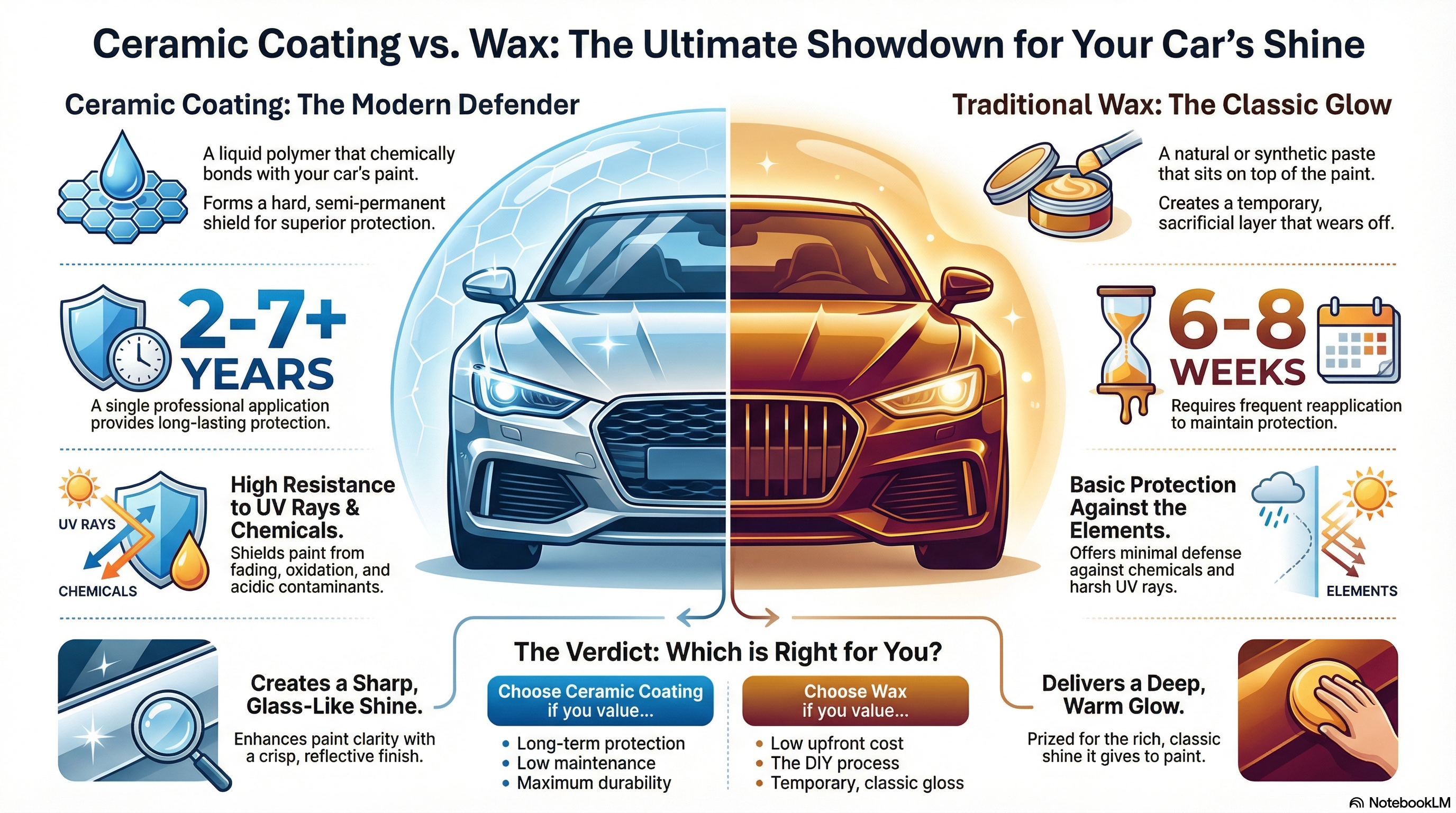
The first and most fundamental truth about ceramic coatings is that they are not a more durable version of wax. The two technologies operate on entirely different principles. Traditional wax relies on mechanical adhesion, meaning its molecules simply sit on top of the paint, filling in microscopic imperfections to create a temporary, sacrificial barrier.
In stark contrast, a true ceramic coating forms a chemical bond with your vehicle's factory clear coat. Through a process called cross-linking, the liquid polymer reacts with the paint surface, creating a semi-permanent molecular bond. It effectively becomes a functional part of your vehicle's paint system. Think of it like the difference between a sticker on a surface (wax) and a dye that permanently colors the fabric itself (ceramic coating). This molecular transformation is the true source of a coating's durability and long-term protection, not just a thicker or harder layer of a wax-like substance.
--------------------------------------------------------------------------------
2. Not All "Ceramics" Are Created Equal: The SiC vs. SiO₂ Showdown
Hidden from most marketing materials is the critical fact that there are two principal variations of ceramic coating chemistry, and the difference is significant. The most common type is based on Silicon Dioxide (SiO₂), often marketed as glass or quartz. In these systems, nanoparticles of SiO₂ are suspended in a resin that cures to form a film over the paint. While effective, its hardness is typically around a 7 on the Mohs scale, and its durability is generally rated for 1-3 years.
The other, less common system is built on Silicon Carbide (SiC). This technology is chemically superior because it doesn't simply suspend particles in a resin. Instead, it forms a direct, continuous bond with the paint through an actual chemical reaction. This creates a harder, more resilient matrix that becomes one with the clear coat.
Yvan at Optimum, whose company pioneered the technology, highlights what makes SiC a fundamentally different—and superior—system:
"Unlike SiO2 based coatings, the SiC based coating actually bonds to the paint and the SiC is formed as a chemical reaction in that process, not by having Nano particles of the ceramic floating in a resin. SiC is superior to SiO2 coatings chemically and has a melting point of 2,730 °C (4,950 °F; 3,000 K) and is a 9 on the Mohs scale of hardness. ... Opti-Coat–Pro becomes one with the paint instead of suspending nano particles of a harder substance in a resin. This gives Opti-Coat Pro far superior chemical resistance, as the chemical must break down the SiC, and not break down a resin holding SiO2 nano particles."
For consumers seeking maximum long-term performance, this distinction is critical. With a higher hardness (9 Mohs) and durability that can range from five years to a lifetime, SiC-based systems represent the pinnacle of current ceramic technology.
--------------------------------------------------------------------------------
3. The High Price Isn't for the Liquid—It's for the Flawless Canvas
Many car owners experience sticker shock when they see the price for a professional ceramic coating, which, according to pricing data from Texas-based professional detailers, can range from $949 to over $2,000. It's a common misconception that this cost is for the bottle of coating itself. In reality, the vast majority of the price is for the extensive and highly skilled labor required to perform paint correction.
Paint correction is a meticulous, multi-stage process of machine compounding and polishing the vehicle's clear coat to remove swirl marks, light scratches, oxidation, and other imperfections. This step is absolutely non-negotiable. Because a ceramic coating forms a semi-permanent bond, it will "lock in" every flaw present in the paint at the time of application. The only way to fix those imperfections afterward is to abrasively compound the entire coating off and start over. Therefore, you're not just paying for a product to be applied; you're investing in the hours of expert labor required to perfect the paint surface into a flawless canvas first.
--------------------------------------------------------------------------------
4. Your Coating Can Get "Clogged"—And Regular Soap Won't Fix It
One of the most persistent myths is that ceramic coatings are "maintenance-free." The more accurate term is "maintenance-efficient." To perform correctly, a coating still requires specific care—and this reveals a surprising problem most owners are never told about.
Over time, especially in areas with hard water, microscopic mineral deposits (calcium and magnesium) can build up on the coating's surface. This layer of baked-on minerals effectively "clogs" the surface, masking its slick, hydrophobic properties. When this happens, you'll notice your car stops beading water and seems to be holding onto dirt more easily.
The counter-intuitive solution is that a regular car wash with pH-neutral soap won't solve the problem. To restore the coating's performance, an occasional wash with a specialized acidic car shampoo (like CARPRO Descale) is required. This type of cleaner is specifically designed to dissolve and remove these bonded mineral deposits, de-clogging the surface and rejuvenating the coating to its original hydrophobic state. It's a critical maintenance step that is essential for long-term performance.
--------------------------------------------------------------------------------
5. Traditional Wax Isn't Obsolete, But It Might Not Survive a Texas Summer
With the rise of durable coatings, where does that leave traditional carnauba wax? Wax still has a place, particularly for its unique aesthetic. Detailing enthusiasts and car show participants prize carnauba for its ability to produce a "warm, deep glow" or a "wet look" that many feel is unmatched.
However, its primary weakness is its low thermal stability. A dark-colored car parked in direct Texas sunlight can easily reach surface temperatures of 160°F or higher. The melting point of most natural carnauba waxes is approximately 160°F. At this temperature, the wax can literally soften and "sweat" off the surface. Once it softens, it loses its protective qualities and can actually trap contaminants against the paint.
While wax remains a great choice for a show car or a garage-kept classic, its lack of durability in high-heat environments makes it an impractical choice for a daily driver compared to thermally stable ceramic coatings, which can withstand temperatures far beyond anything a car's surface will ever experience.
--------------------------------------------------------------------------------
Conclusion: The Science Behind a Lasting Shine
Choosing the right paint protection is about understanding the underlying technology, not just the marketing claims. A ceramic coating isn't a magic shield; it's a long-term chemical bond with your vehicle's paint. As we've seen, the type of chemistry (SiC vs. SiO₂) matters immensely, the cost is tied to the critical labor of paint correction, and long-term performance is entirely dependent on proper maintenance to keep the surface clean and unclogged.
Now that you understand the science, is a semi-permanent chemical bond the right investment for your vehicle's future?
