Pet Hair Removal: Clean Car Tips for Fort Worth (2026)
More Than a Mess: The Surprising Science of How Dog Hair Is Destroying Your Car
1.0 Introduction: The Universal Struggle of the Fur-Coated Car
If you're a dog owner, you know the universal truth: fur gets everywhere. It’s a reality that 59% of pet owners identify as a major household challenge, but that struggle becomes a full-blown war inside the confined, super-heated space of a car. And here in Fort Worth, our climate turns that war nuclear.
Have you ever wondered why dog hair seems to weave itself into your car's upholstery with superhuman strength, resisting even the most powerful vacuums? It’s not your imagination. You're fighting a scientific battle amplified by Texas heat and our outdoor lifestyle. This article will reveal the surprising truths about what's really happening to your car's interior at a microscopic level and provide expert-backed advice on how to finally win the war on fur.
2.0 Takeaway 1: It’s Not Just Stuck, It’s a Scientific Bond
You might think dog hair is just sitting on your seats, waiting for a vacuum. The reality is far more sinister. At a microscopic level, each strand is waging a three-part scientific assault to permanently bond with your car's interior.
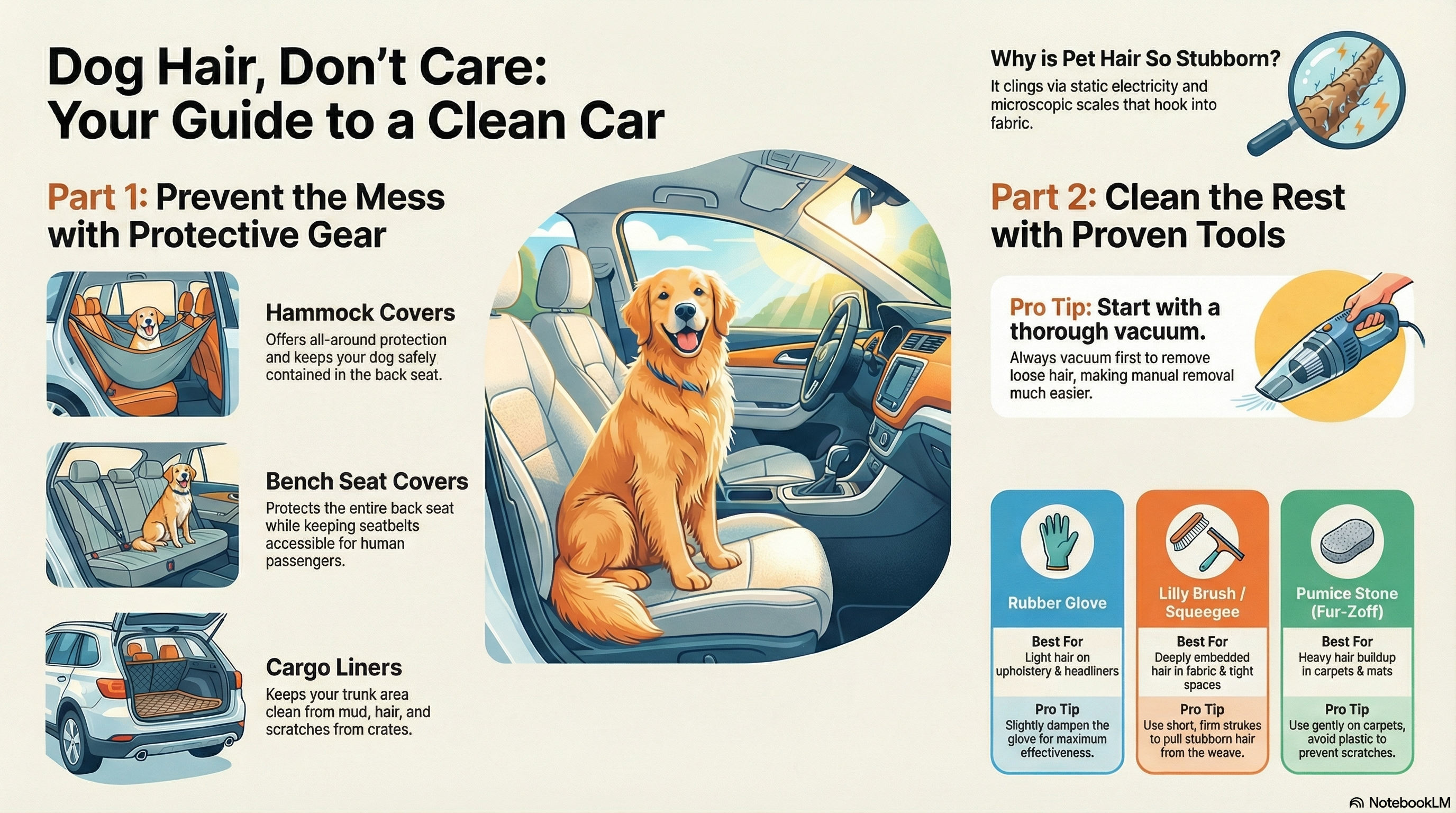
First, Electrostatic Attraction acts like a magnet. As your dog shifts around on the seats, the friction—a process called the triboelectric effect—creates a static charge. This electrical imbalance makes loose hairs literally leap onto and cling to upholstery surfaces, especially in the dry Texas air.
Second, Mechanical Interlocking turns every hair into a tiny grappling hook. A single strand of dog hair is covered in microscopic, overlapping scales or "barbs." These barbs physically snag and lock into the woven fibers of your car’s seats and carpets, embedding themselves deep within the material where vacuums can’t reach.
Finally, a Biological Glue finishes the job. Your dog’s natural skin oils and dander don't just sit on the surface; they act as a secondary organic adhesive. This sticky film helps to bond the already hooked hairs even more firmly to the upholstery fibers, creating a stubborn, layered mess.
3.0 Takeaway 2: Your Car's Upholstery Is Being Sandpapered from the Inside Out
Professional detailers in Fort Worth have a term for the long-term damage caused by embedded pet hair: the "sandpaper effect." When passengers sit and move, the stiff, barbed hairs lodged in the seats constantly rub against the upholstery. This isn't just a mess; it's a structural threat.
This microscopic friction slowly grinds down and thins the fabric. The problem is made worse by our local environment; the hair traps abrasive particles like North Texas clay and pollen from neighborhoods like Arlington Heights, turning your seats into a low-grade sanding block. Over time, this mechanical wear leads to premature fraying, bald spots in the carpet, and a fundamental loss of your interior's structural integrity.
4.0 Takeaway 3: That "Dog Smell" Is Actually a Science Experiment Gone Wrong
That persistent "dog smell" isn't just from your furry friend. It's the byproduct of microscopic decay supercharged by the Texas heat. The problem is magnified by the lifestyle of a typical Fort Worth dog owner. A trip to the popular ZBonz Dog Park means bringing pond water and mud back into the car, while a run through Fort Woof at Gateway Park loads the carpets with grass and pollen.
This organic cocktail of fur, dander, oils, and moisture gets trapped deep in your seats. In the brutal heat of a car parked in a Fort Worth summer, where interior temperatures can easily exceed 140 degrees Fahrenheit, this mixture becomes a perfect incubator for bacteria. The heat accelerates this bacterial growth, creating a stubborn odor that comes from deep within the seat cushions and carpet padding. It’s why simple vacuuming fails—you can't vacuum away a bacterial colony.
5.0 Takeaway 4: You Can Break Your Car's Ceiling by Cleaning It
It may seem like the toughest surface to clean, but your car’s headliner is actually one of its most fragile parts. The fabric you see is bonded to a foam-core board with a specialized, temperature-sensitive adhesive.
Using a steam cleaner or applying too much moisture or aggressive pressure can dissolve this adhesive. When the bond fails, the fabric delaminates from the foam board, resulting in a "sagging" headliner that is expensive and difficult to replace. Professionals recommend the "gentle skim" technique: use a lightly dampened rubber glove or a clean microfiber towel to create just enough friction to clump the hair without pulling on the delicate fabric.
6.0 Takeaway 5: The Most Effective Removal Tools Might Already Be in Your Home
You don't always need to buy expensive gadgets to fight back against fur. Some of the most potent tools are simple items you probably already have.
Rubber Gloves or Squeegees: When you rub a standard rubber glove or a window squeegee over fabric, the friction and static electricity lift and clump pet hair into satisfying piles, making it easy to vacuum up.
Pumice Stones: Used carefully by professional detailers, pumice-like stones are excellent for dislodging deeply embedded hair from durable carpets. Use gentle, short strokes to avoid snagging the fabric.
A Balloon: For the ultra-delicate headliner, an inflated balloon is a brilliant, zero-risk solution. First, build a strong static charge by rubbing it vigorously on your own clothes or hair. Then, simply hover the charged balloon an inch or so above the fabric. You'll see the loose hairs lift off and stick to the balloon as if by magic, no physical contact required.
7.0 Takeaway 6: The Ultimate "Hack" Isn't a Tool, It's a Barrier
The most effective long-term strategy isn't removal, but prevention. Investing in a high-quality barrier is the single best way to protect your car's interior. While leather seats are easier to wipe hair from, they are highly susceptible to scratches from claws. This is why high-performance fabric covers are the superior choice.
Modern dog seat covers are far more than blankets. Brands like K9 Ballistics offer options made from non-porous, scratch-resistant fabrics like reinforced PVC-backed polyester or 1000 Denier CORDURA®. These materials are waterproof and tough enough to prevent sharp "needle hairs" from piercing through and embedding in the seats below. A well-fitted cover keeps all the hair, dirt, and claw marks off your actual car seats, turning a deep-cleaning nightmare into a simple task of removing and washing the cover.
8.0 Conclusion: A Final Thought
As we've discovered, managing pet hair in your vehicle—especially here in Fort Worth—is about understanding the science behind the problem, not just about brute-force cleaning. From electrostatic bonds supercharged by dry air to bacterial growth accelerated by Texas heat, the forces at play are complex but entirely manageable with the right knowledge.
Now that you know your dog's fur is waging a scientific war on your car's interior, what's the first change you'll make to fight back?
